
If you've ever spread fertilizer only to watch your grass turn yellow, sputter, or just plain ignore your effort — the timing was probably off. Knowing when to fertilize your lawn in Indiana isn't just about grabbing a bag from the hardware store whenever it goes on sale. It's about working with Indiana's soil temperatures, cool-season grass cycles, and seasonal rainfall patterns to get the most out of every application.
At Hope Grows Indy, we've spent years maintaining and transforming lawns across Hamilton County — from Fishers and Noblesville to Westfield and Carmel. What we've learned firsthand is this: the right fertilizer at the wrong time is money down the drain. This guide gives you the exact month-by-month schedule we use for Indiana lawns, plus the NPK guidance, soil temperature triggers, and product pointers that make the difference between a lawn that survives and one that thrives.
Understanding Indiana's Lawn Grass Types Before You Fertilize
Before you open a single bag, you need to know what you're feeding. The vast majority of Indiana lawns — particularly in the Indianapolis metro and Hamilton County corridor — are planted with cool-season turfgrasses. The three most common are:
- Kentucky Bluegrass – Dense, dark green, spreads via rhizomes; the go-to for premium Indiana lawns. Requires 4–6 lbs. of nitrogen per 1,000 sq. ft. per year.
- Tall Fescue – Coarser blade, deeper roots, more drought-tolerant. Requires 2–4 lbs. of nitrogen per 1,000 sq. ft. per year.
- Perennial Ryegrass – Fast germination, common in overseeded lawns. Requires 3–5 lbs. of nitrogen per 1,000 sq. ft. per year.
Cool-season grasses grow most aggressively in spring (April–June) and fall (September–November), and naturally go semi-dormant during Indiana's hottest summer weeks. Your fertilization schedule should mirror this growth curve exactly — heavy investment in the growth windows, minimal intervention during summer stress.
Pro Tip from the Field: Before fertilizing any new lawn area, pull a soil test through Purdue Extension. Indiana soils vary significantly between clay-heavy Hamilton County plots and sandier Marion County terrain. A soil test tells you your pH (target 6.0–7.0) and existing nutrient levels so you're not over-applying phosphorus into already saturated ground.
The Indiana Lawn Fertilization Schedule: Month by Month
March – Soil Prep, Not Fertilizer
Soil Temp: 38–48°F Fertilize? ❌ No
Resist the urge. Grass roots are not yet active at these temperatures, and early nitrogen application feeds weeds (hello, crabgrass) before your turf can even compete.
Your March job is soil prep: dethatch if needed, aerate compacted areas, and apply a pre-emergent crabgrass preventer when soil temps hit 50°F consistently — typically late March in Hamilton County.
Fertilizer this month? No. But schedule your soil test and have your fertilizer program mapped before April hits.
April – Light Starter Fertilization (Spring Round 1)
Soil Temp: 50–60°F
Fertilize? ✅ Yes
NPK: 20-5-10 or 18-6-12
Rate: 0.5–0.75 lbs. N / 1,000 sq. ft.
Once soil temps break 50°F for five consecutive days (roughly mid-April in Central Indiana), it's time for your first application of the season. At this stage, the goal is to wake up root systems and encourage lateral spread, not produce a burst of top growth. Use a slow-release nitrogen source (look for products with sulfur-coated urea or IBDU on the label) to avoid burning early spring blades that are still tender.
First-hand guidance: When we apply spring fertilizer for Hamilton County clients, we use a broadcast rotary spreader set at roughly 60–70% of the bag's recommended rate on the first pass, then do a perpendicular second pass at 30–40% to ensure even coverage without striping. This "split-pass" technique eliminates the uneven green-yellow-green pattern you'll see in neighbors' yards by May.
Related Service: If your lawn needs more than fertilizer this spring, our lawn care and maintenance services include aeration, overseeding, and a full spring cleanup to give your turf the best possible start.
May – Spring Peak Feeding (Spring Round 2)
Soil Temp: 60–70°F
Fertilize? ✅ Yes
NPK: 32-0-10 or 24-0-12
Rate: 0.75–1.0 lbs. N / 1,000 sq. ft.
This is prime growth season. A second application 4–6 weeks after your April feeding capitalizes on peak root activity and active shoot growth. If you're overseeding thin areas or repairing winter damage, May is also when a starter fertilizer (higher phosphorus: think 10-20-10) pays dividends for germinating seed areas specifically.
Sizing Advice: A standard 40-lb. bag of granular fertilizer covers approximately 10,000–12,000 sq. ft. at a 0.75 lb. nitrogen application rate. Measure your lawn area before buying. A 5,000 sq. ft. lawn only needs half a bag — over-applying in May is the #1 cause of summer burnout in Indiana lawns.
June – Slow Down or Skip
Soil Temp: 70–80°F
Fertilize? ⚠️ Caution only
Rate: 0.5 lbs. max if needed
Approach June fertilization with caution. Once soil temperatures break 70°F (typically mid-June in Hamilton County), cool-season grass naturally slows its shoot growth and begins redirecting energy to root development and stress tolerance.
If you apply heavy nitrogen in June, you'll force top growth at the exact moment the plant is trying to conserve resources — leading to disease pressure (brown patch, dollar spot) and a weakened root system heading into July's heat. If you fertilize, use a low, slow-release nitrogen product — no more than 0.5 lbs. of actual nitrogen per 1,000 sq. ft.
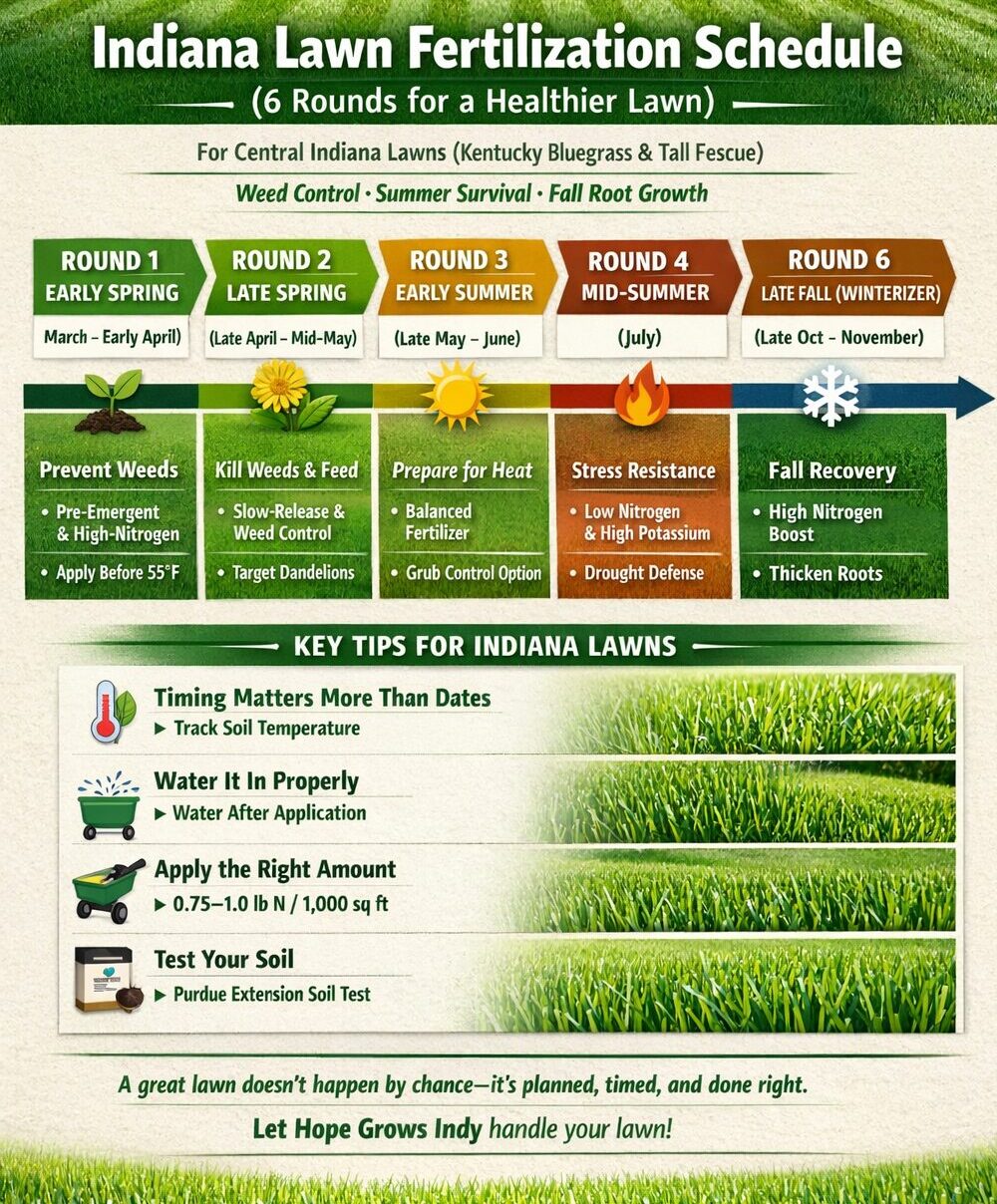
July – No Fertilization for Most Indiana Lawns
Soil Temp: 80–90°F+
Fertilize? ❌ No
Put the spreader away. This is the lawn's survival window. Focus on deep, infrequent watering (1–1.5 inches per week, applied in one or two sessions) to maintain root depth.
Applying fertilizer to a heat-stressed lawn in July is one of the fastest ways to create dead spots. If your lawn goes slightly dormant (turns grayish-tan), that's normal — it will recover in September.
August – Transition Preparation
Soil Temp: 75–85°F declining
Fertilize? ❌ No
By mid-to-late August, Indiana soil temperatures start their decline. This is your setup window — not for feeding, but for fall overseeding prep. Dethatch, aerate, and prepare thin areas for September seeding.
September – The Most Important Feeding of the Year (Fall Round 1)
Soil Temp: 60–70°F dropping
Fertilize? ✅ Yes — High Priority
NPK: 32-0-10 or 28-0-12
Rate: 1.0 lb. N / 1,000 sq. ft.
September is the single most impactful month in the Indiana lawn fertilization calendar. Cool-season grasses respond more dramatically to fall fertilizer than any other season because they're directing nutrients into root development and carbohydrate storage — the reserves that fuel next spring's green-up.
First-hand guidance: On Hamilton County lawns we maintain, our September application is always our highest-rate feeding of the year — typically a full 1.0 lb. N/1,000 sq. ft. using a 50% slow-release product. The slow-release component bridges into October, extending the feeding window without a second trip.
Explore Our Fall Lawn Care Services: Ready to let the pros handle it? Our seasonal lawn care programs include fall aeration, overseeding, and a timed fertilization package built around Indiana's specific soil temperature calendar.
October – Fall Winterizer Application (Fall Round 2)
Soil Temp: 50–60°F
Fertilize? ✅ Yes
NPK: 24-0-12 or 25-0-15
Rate: 0.75–1.0 lbs. N / 1,000 sq. ft.
Your second fall application — commonly called the "winterizer" — is applied 4–6 weeks after your September feeding, typically in the first two weeks of October. The elevated potassium (K) in winterizer formulations strengthens cell walls against freeze-thaw stress, improves disease resistance, and helps carbohydrates move from blades down into root tissue before dormancy.
Pro Tip: Apply your winterizer when the lawn is still actively growing (at least 2–3 mowings remaining in the season). Applying after the first hard frost locks nutrients in the soil with no root uptake — you've just wasted product.
November – Final Mow, No More Fertilizer
Soil Temp: Below 50°F
Fertilize? ❌ No
Final mow at 2.5–3 inches. No fertilizer. The root system is closing down for the season. Any nitrogen applied now will not be absorbed and is at high risk of leaching into stormwater — a particular concern in Hamilton County's interconnected watershed draining into White River.
December–February – Dormant Season
Fertilize? ❌ No
Nothing. Let the lawn rest. Use this time to sharpen mower blades, calibrate your spreader, and schedule spring aeration and soil testing for March.
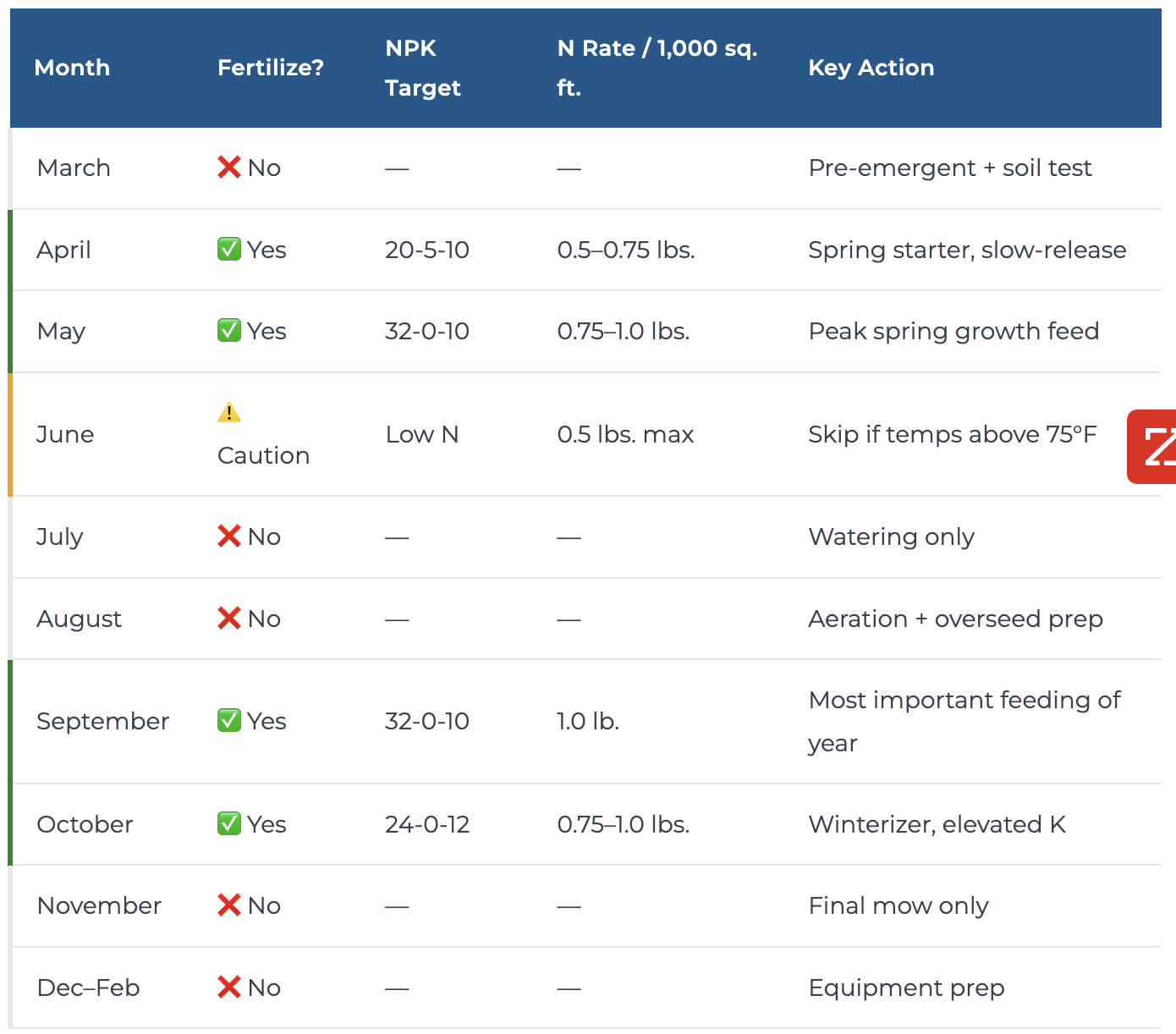
Quick-Reference: Indiana Lawn Fertilization Calendar
How to Read a Fertilizer Bag: NPK Explained for Indiana Homeowners
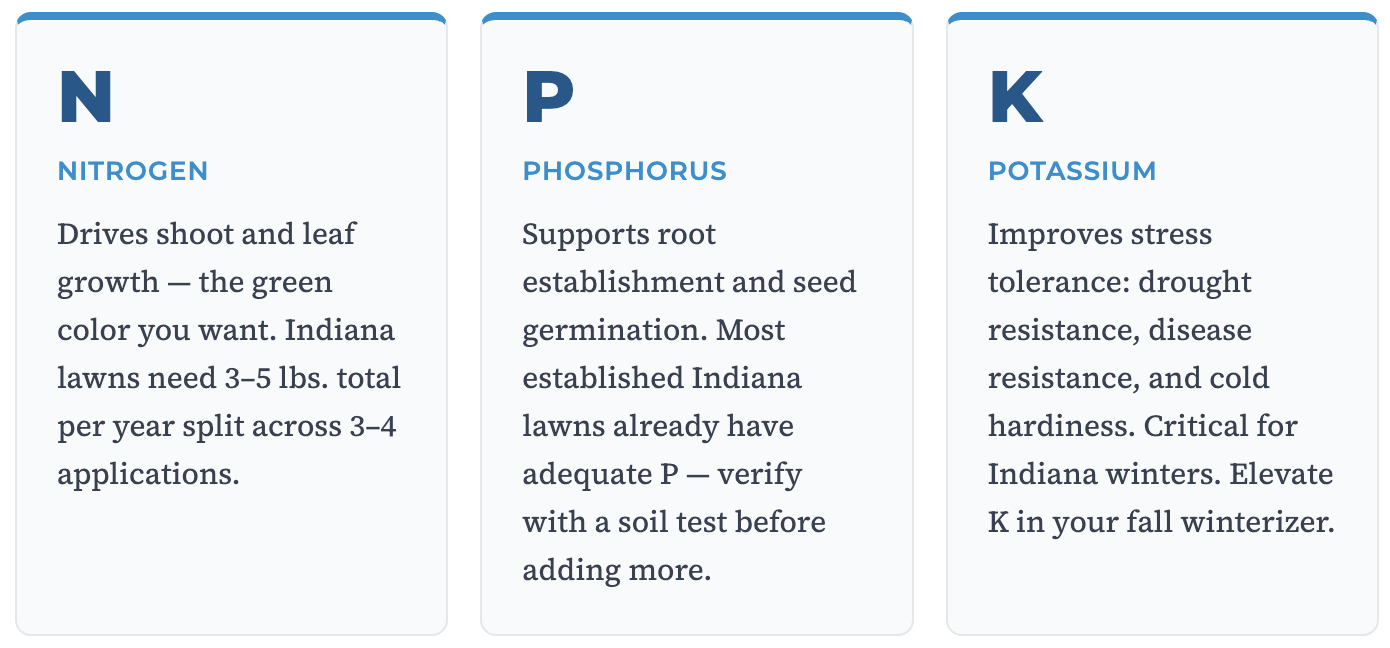
Every fertilizer bag lists three numbers: N-P-K (Nitrogen – Phosphorus – Potassium). Here's what each does for your Indiana lawn:
Slow-Release vs. Fast-Release: For Indiana lawns, we recommend at least 30–50% slow-release nitrogen in all spring and fall applications. Fast-release (soluble nitrogen) produces a quick green-up but fades fast and risks burning in warm temperatures. Slow-release products (sulfur-coated urea, IBDU, polymer-coated urea) feed steadily over 6–10 weeks and are dramatically more efficient in Indiana's variable weather.
Common Indiana Lawn Fertilization Mistakes to Avoid
Let Hope Grows Indy Handle Your Lawn Fertilization This Season
Following the right schedule makes a measurable difference — but the execution matters just as much as the timing. Uneven application, incorrect calibration, or off-label rates can undo a perfectly timed program.
Hope Grows Indy provides professional lawn fertilization and seasonal lawn care programs for homeowners across Hamilton County — including Westfield, Noblesville, Fishers, and Carmel. Our crews are trained, locally experienced, and backed by our mission of providing second-chance employment to individuals who are working hard to build new lives.
When you hire Hope Grows Indy, you're not just investing in a healthier lawn — you're investing in your community.